

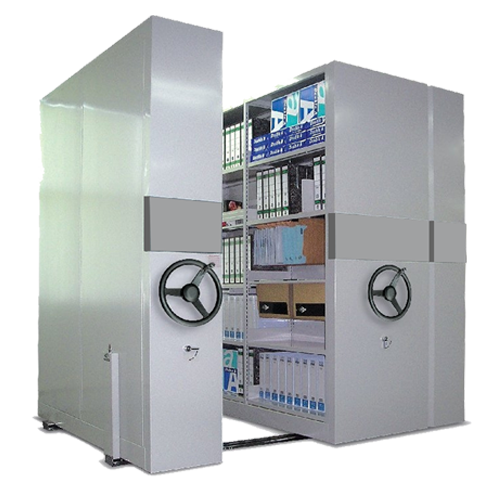

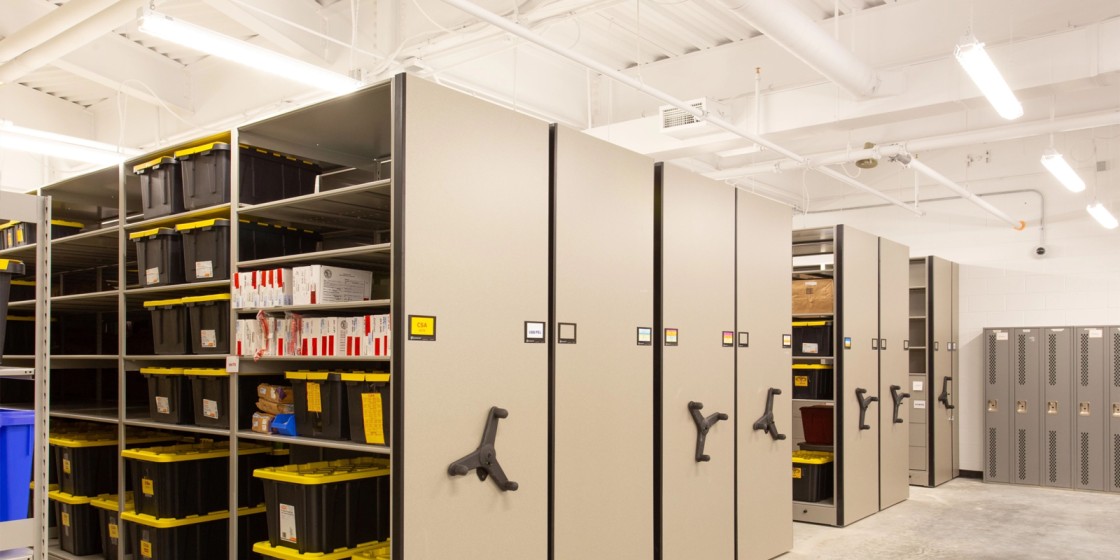
Mobile shelving for offices helps organisations consolidate files, records and suitable workplace materials by reducing the number of permanently open aisles required between shelving rows. Shelving units move along a controlled base or track, allowing an access aisle to be opened only where stored materials need to be retrieved.
Office storage can gradually occupy valuable floor space as documents, archived files and administrative materials accumulate. In Singapore workplaces where available space may need to support desks, meeting areas, collaborative spaces and other business functions, inefficient filing storage can place additional pressure on the office layout.
Mobile office shelving provides one way to organise physical materials more compactly. Its suitability depends on the quantity and dimensions of stored items, retrieval frequency, user access, security requirements and how storage fits into everyday office workflows.
Why Office Storage Can Take Up Valuable Floor Space
Office storage systems can consume substantial floor space when filing cabinets and static shelving require permanent access areas around them. The issue is not only the physical footprint of the shelves but also the circulation space needed to reach each storage unit.
Traditional records shelving commonly uses parallel fixed rows separated by aisles. Those aisles remain open regardless of whether staff are retrieving files from them. As storage requirements increase archived files may continue accumulating unless an organisation regularly reviews its physical retention needs.
Several factors commonly contribute to inefficient office storage:
Multiple fixed aisles between shelving rows
Storage furniture distributed across different office areas
Poor use of vertical shelf space
Inconsistent file and archive organisation
Retained materials that are rarely accessed
An efficient office storage system should therefore consider both the physical shelving arrangement and how the organisation manages its records.
What Is Office Mobile Shelving?
Office mobile shelving is a compact storage arrangement in which shelving bays are installed on movable bases rather than remaining permanently separated by fixed aisles. The units can be moved to create an access aisle at the required location.
This arrangement allows multiple shelving rows to share an aisle. When a particular section is not being accessed, adjacent bays can remain positioned close together. The basic difference between conventional and mobile office storage is straightforward:
Storage Feature | Static Office Shelving | Mobile Office Shelving |
Shelving position | Fixed | Movable |
Aisles | Multiple permanent aisles | Shared access aisle or aisles |
Floor-space allocation | More area used for circulation | More area can be allocated to storage |
Storage density | Limited partly by fixed aisles | Higher-density arrangement possible |
Access method | Rows remain continuously open | Required aisle is opened for access |
The objective is not simply to install more shelves. Mobile shelving should create an organised storage area that uses floor space efficiently while remaining practical for staff.
Organising Files and Documents
Organised filing allows employees to identify the correct storage location before opening a mobile shelving aisle. A clear classification system is therefore an important part of office records shelving.
Files can be grouped according to department, project, document category, year, reference number or another structure that reflects the organisation’s workflow. The same system should be applied consistently so that staff can return records to their correct locations.
Active and archived records may also benefit from separate classifications. Active records typically require more frequent access, while archived documents can often be placed within denser sections of the storage arrangement.
Useful organisational measures include:
Assigning clear reference numbers to shelving bays.
Labelling individual shelves or document categories.
Separating active files from long-term archives.
Maintaining consistent filing and return procedures.
Reviewing stored records according to applicable retention requirements.
A compact shelving system cannot compensate for disorganised filing. Physical density and information organisations need to work together for office storage to remain efficient.
Reducing Fixed Aisles
Mobile shelving reduces fixed aisle requirements by allowing several rows of storage to share a smaller number of access aisles. This can increase the proportion of a storage room that is used for shelving.
Consider an office archive containing several parallel shelving rows. Under a conventional layout, an aisle may be required between each row so employees can access both sides of the shelving.
With compact storage, shelving bays can be positioned together when access is not required. Users move the appropriate units to open an aisle at the section containing the required file or material.
The resulting floor-space efficiency can support two different office objectives. An organisation may use the same room to accommodate more storage, or it may maintain its required storage capacity within a smaller footprint.
Which approach is more appropriate depends on the wider office plan. A growing archive may need additional capacity, while an office redesign may place greater value on releasing space for other workplace functions.
Access for Frequently Used Records
Frequently used records should be positioned so employees can retrieve them without unnecessary shelving movements. Retrieval frequency is therefore an important consideration when deciding where different document categories are stored.
Not all office records have the same access pattern. Some files may be needed every day, while completed project documents or historical records may remain untouched for months.
A practical storage plan can divide records into broad access categories. Frequently used files can occupy easily accessible positions, while lower-frequency archives can be placed in sections where compact storage density takes greater priority.
The number of employees using the storage area should also be considered. A small archive accessed occasionally by one or two staff members has different aisle requirements from a central records room used continuously by several departments.
Mobile shelving is most appropriate when the ability to consolidate aisles remains compatible with required access. Maximising storage density without considering retrieval patterns can create avoidable delays in daily work.
Shelf Configuration and Security
Shelf configuration determines how effectively office mobile shelving accommodates files, folders, archive boxes and other workplace materials. Security controls determine who can access the storage area and particular categories of records.
Shelf height should correspond with the dimensions of stored items. Excessive vertical clearance creates unused space, while shelves positioned too closely together can make files difficult to remove and replace.
Shelf depth also matters. Standard document folders may require a different configuration from archive boxes or larger administrative materials. Adjustable shelves can provide flexibility when the office stores different document formats or when storage requirements change.
Security should be considered separately from capacity. Offices may hold personnel records, contracts, financial documents or other confidential materials that should not be accessible to every employee.
Depending on organisational requirements, appropriate controls can include restricted storage rooms, defined user permissions and internal records-handling procedures. Mobile shelving should form part of these controls rather than being treated as a substitute for information security practices.
Suitable Office Applications
Mobile office shelving is suitable for storage applications where a relatively large volume of organised materials needs to be accommodated without keeping every aisle continuously open. The system can support both active and archival office storage when access patterns are appropriate. Common applications can include:
Corporate and administrative records
Project and reference files
Archive boxes and historical documents
Selected office supplies
Departmental filing collections
Suitable document libraries and resource materials
Different applications require different configurations. A legal or administrative archive may rely heavily on file classification, while an office supplies area may require more varied shelf spacing.
Mobile shelving may be less appropriate for materials that need unrestricted simultaneous access throughout the day. Offices should therefore assess how employees actually use stored items before deciding which categories belong in compact storage.
Centralising Office Storage
Centralised storage can reduce the need for separate filing cabinets and shelving units distributed throughout multiple office areas. Mobile shelving can support this approach by concentrating appropriate records and materials within a dedicated storage zone.
Distributed filing can be convenient for individual teams, but it may also create duplicated storage and inconsistent organisation. Departments may retain similar reference materials or use different filing systems for related records.
A centralised office storage system can provide a common location and classification structure. Whether centralisation is appropriate depends on departmental workflows and how frequently employees require immediate access to particular files.
A hybrid approach may also be practical. Frequently used working documents can remain near relevant teams, while inactive records and shared archives are consolidated within mobile shelving.
The purpose of centralisation should be to improve organisation and space use without unnecessarily increasing retrieval time.
Planning Storage Around Daily Workflows
Office storage should be planned around how employees retrieve, use and return materials during a normal working day. A mobile shelving layout that provides high theoretical capacity may still be inefficient if it conflicts with everyday workflows.
The planning process should begin by identifying who uses the storage area. Departments, number of users and typical access periods can influence where the system is positioned and how many aisles need to be available.
Retrieval patterns should then be documented. Frequently requested documents should be positioned strategically, while low-use records can occupy sections where access speed is less critical.
The movement of materials outside the shelving area also matters. Staff need sufficient space to remove files or boxes and transport them to nearby work areas without obstructing circulation. Ensure to consider:
Which employees need access
What materials they retrieve
How frequently retrieval occurs
Whether simultaneous access is common
Where documents go after retrieval
How records are returned and refiled
These factors help determine whether compact shelving supports office operations rather than simply increasing storage density.
Planning for Records Growth
Record growth should be considered when determining how much mobile shelving capacity an office requires. Physical document volumes can change as organisations expand, complete additional projects or retain records over longer periods.
Current storage volume provides a baseline, but it should not automatically define the full capacity requirement. Organisations can estimate future needs using their historical rate of records accumulation and expected operational changes.
Storage growth should also be managed through appropriate records policies. Keeping every document indefinitely can create unnecessary pressure on physical storage regardless of how efficiently shelving is configured.
Regular reviews can identify records that have reached the end of their applicable retention period or no longer need to remain in active office storage. Decisions about retention and disposal should follow the organisation’s legal, regulatory and internal requirements.
Mobile shelving can accommodate growth more efficiently than some fixed layouts, but physical capacity remains finite. This is why storage planning and records management should operate together.
Maintaining an Organised Mobile Filing System
An organised mobile filing system requires ongoing management after the shelving has been installed. Labelling, filing procedures and periodic reviews help prevent storage efficiency from declining over time.
Files should be returned consistently to their assigned locations. Misfiled documents can be more difficult to locate in a high-density system because users may need to check multiple movable sections.
Shelf labels should remain clear and should be updated when storage categories change. If the organisation uses a digital records index, physical location references can be aligned with the system so employees know which bay to access.
Periodic storage reviews can also identify overcrowded sections and underused shelf areas. Rebalancing categories may improve capacity without changing the physical shelving layout.
The objective is to maintain a storage system that remains understandable to authorised users rather than allowing organisation to depend on individual staff knowledge.
Frequently Asked Questions
How does mobile shelving for offices save floor space?
Mobile shelving for offices reduces the number of permanently open aisles required between shelving rows. Multiple movable bays can share an access aisle, allowing more of the available floor area to be used for storage.
What office materials can be stored on mobile shelving?
Mobile shelving can accommodate files, records, archive boxes, reference materials and suitable office supplies when the shelf dimensions and load requirements are appropriate. The configuration should be selected according to the actual materials being stored.
Is mobile shelving suitable for frequently used office files?
Mobile shelving can support frequently used files when the layout accounts for retrieval patterns. High-use records should generally be positioned for convenient access, while lower-frequency archives can occupy denser storage sections.
Can mobile shelving be used for confidential office records?
Mobile shelving can form part of a storage arrangement for confidential records when suitable physical and organisational access controls are implemented. Organisations should apply their own records management and information security requirements to sensitive documents.
What should an office assess before planning mobile shelving?
An office should assess available floor space, existing storage volume, file dimensions, retrieval frequency, number of users, security requirements and expected records growth. The surrounding workplace layout and daily movement of materials should also be considered.
Creating a More Space-Efficient Office Storage Environment
Mobile shelving for offices can reduce the floor area occupied by fixed storage aisles while providing structured space for files, archives and suitable administrative materials. The resulting compact storage arrangement can either increase capacity within an existing room or help reduce the overall footprint dedicated to storage.
For Singapore offices, effective use of limited floor space requires more than installing additional shelving. Storage density, retrieval frequency, shelf configuration, security and records management should be considered together so that the system remains practical for daily use.
Reassess How Much Office Space Your Files Require
Files and archived records can occupy more workplace space than necessary when storage grows around fixed cabinets and permanent aisles. Is your office reviewing how physical records can be organised in the available space? Contact Tysen Technologies to assess whether mobile shelving is a suitable solution.


