

In a busy warehouse, a few metres can make a significant difference to how safely a vehicle passes a loading area or how clearly a restricted zone is defined. Poorly positioned protection can narrow a route, create awkward turns, or simply move the problem elsewhere.
Flexible traffic bollards can help facilities make vehicle routes more predictable by marking key points rather than filling an entire area with barriers. The most effective layout starts with understanding how vehicles actually move through the facility.
For warehouses, manufacturing facilities and other industrial environments in Singapore, bollard placement should account for vehicle dimensions, turning behaviour, loading activities, and areas where vehicles operate close to structures or equipment.
What Are Flexible Traffic Bollards?
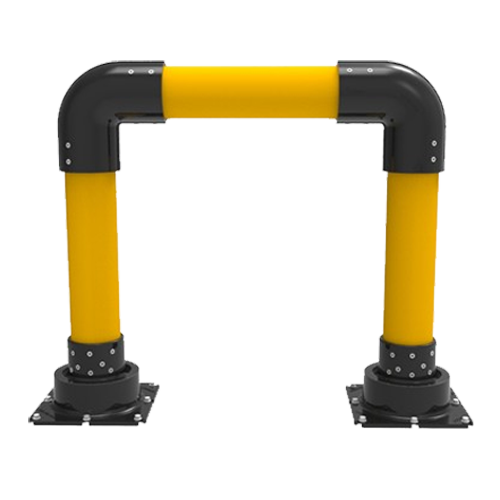
Flexible traffic bollards are impact-resistant posts used in warehouses, factories, loading bays, and other facilities. They help protect vulnerable structures and equipment while supporting vehicle guidance within the facility. However, they should not be confused with flexible delineator posts, which are not safety bollards and primarily mark routes or restricted areas. Unlike rigid posts, flexible polymer bollards can deflect when struck within their specified operating conditions.
In industrial facilities, they can be positioned around:
- Vehicle route edges
- Turning areas
- Doorways and access points
- Vulnerable equipment
- Exposed infrastructure
- Restricted operational zones
For example, the A-Safe Bollard 130 is a compact bollard intended for confined spaces, including warehouses, loading bays and tight operational zones. The A-Safe 190 bollard is a larger flexible bollard designed to protect structures and equipment while providing a visible physical presence around vehicle routes.
The appropriate bollard depends on what needs to be protected, the vehicles operating nearby and the likely impact conditions.
Tip 1: Map Actual Vehicle Routes Before Positioning Bollards
A warehouse floor plan does not always show how vehicles move during day-to-day operations. Forklifts may take wider turns around temporary stock, reverse into loading areas or repeatedly approach the same doorway or corner.
Before installing flexible bollards, review:
- Regular vehicle travel paths
- Turning and reversing movements
- Loading and unloading approaches
- Intersections between vehicle routes
- Areas where vehicles operate close to structures or equipment
This provides a more practical basis for vehicle guidance. It can also highlight problems that bollards cannot solve. If a forklift repeatedly cuts across a corner because the designated route is difficult to follow, adding more bollards may simply create another obstruction. The underlying layout should be reviewed first.
Tip 2: Use Bollards to Make Direction Changes Clear
Not every part of a vehicle route needs a bollard. Concentrating protection at points where vehicle movement changes can provide clearer guidance without unnecessarily restricting the operating area. Consider using flexible bollards to identify:
- The start of a restricted zone
- The edge of a turning area
- An entrance to a vehicle-only route
- The approach to exposed infrastructure
- A change in the direction of travel
The A-Safe Bollard 130, for example, is designed for confined operational areas where protection is needed around doorways, corners and equipment. Its compact format makes it relevant where a larger protection system could take up unnecessary space.
Bollards should still leave enough clearance for the vehicles and loads using the route. If vehicles repeatedly contact the same bollard, review the route and positioning rather than simply adding more posts.
Tip 3: Match Bollard Placement to the Vehicles Using the Area
A route used by a forklift cannot necessarily be planned in the same way as one used by smaller material-handling equipment. Vehicle dimensions, load size, and manoeuvring behaviour all affect the amount of space required.
Rear swing and reversing movements can also bring vehicles closer to walls, machinery, racks and other fixed assets. When planning bollard positions, consider:
- Vehicle width and length
- Load dimensions
- Turning radius
- Rear swing
- Operating direction
- Frequency of vehicle movement
- Clearance from structures
This is particularly important in Singapore warehouses where available floor space may need to accommodate several operational activities within the same facility.
Warehouse Traffic Routes

Warehouse traffic routes often bring forklifts close to racking, machinery, loading areas and other fixed infrastructure. Repeated movement through these areas means that even occasional contact can become a recurring source of damage.
Flexible bollards can be used at selected points along these routes to provide a visible boundary and protect exposed areas. The A-Safe iFlex 190 bollard, for example, is available in 835 mm, 1,200 mm and 2,000 mm height options and is designed for impact protection around structures and equipment. Its published specification gives a nominal impact energy absorption capacity of 6,900 joules, with the stated test conditions including a 90° impact angle.
This makes the product specification an important part of selection. A bollard should not be chosen simply because it looks suitable for a particular warehouse area. The expected vehicle impact conditions should be considered against the product’s tested performance.
Tip 4: Avoid Using Bollards to Compensate for Poor Route Design
Repeated impacts can indicate more than a need for stronger protection. If forklifts regularly strike a bollard at the same location, investigate whether:
- The turning area is too tight
- Temporary storage is reducing clearance
- The vehicle route is poorly defined
- The bollard is positioned too close to the travel path
- Loads are changing the vehicle’s operating envelope
Flexible bollards should support an appropriate route rather than force vehicles through one that is difficult to navigate. This distinction is important in busy warehouses. A protection system that reduces the usable operating space may create a new traffic problem even if it protects the structure behind it.
Protecting Vulnerable Points Along Vehicle Routes
Some locations need more than visual route definition because vehicles operate close to assets that could be damaged by impact, such as doorways, building corners, machinery, fixed equipment, or areas beside loading operations.
The level of protection should correspond with the vehicle activity at each location. A lightly used area may have different requirements from a loading zone where forklifts operate continuously. For instance the A-Safe Bollard 130 is ideal for areas with vulnerable structures and vehicle movement in confined areas, like doorways, while the A-Safe iFlex 190 bollard provides a different protection option for industrial areas where greater impact resistance may be required.
Flexible bollards should therefore be selected and positioned according to the specific risk rather than applied uniformly throughout the facility.
Tip 5: Consider Pedestrian Segregation Where Routes Intersect
Vehicle guidance should be considered alongside pedestrian movement. In warehouses and manufacturing facilities, employees may need to cross or work close to forklift routes, making clear pedestrian segregation an important part of the overall traffic management arrangement.
Flexible bollards can help identify boundaries and access points, but individual bollards do not provide continuous physical separation. Where vehicles and pedestrians share operational space, the facility should consider whether additional physical separation, markings, signage or controlled crossing points are required.
The objective is to make both vehicle and pedestrian movement predictable rather than relying on a single type of safety equipment.
Tip 6: Keep Visibility and Route Definition Consistent

A bollard is more useful when its position and purpose are immediately apparent to operators. In warehouses, stored materials, pallets, machinery and racking can affect visibility.
Bollards should therefore be positioned where they remain reasonably visible during normal operations and do not create unnecessary visual clutter. Consistent placement can also help operators recognise similar route boundaries throughout a facility.
However, visibility alone does not determine whether a bollard provides adequate protection. The product’s performance and suitability for the expected impact conditions still need to be considered.
Choosing the Right Bollard Configuration
The right bollard depends on what your facility needs to control or protect at each location. Before selecting flexible safety bollards, consider:
- Vehicle route: Where should vehicles travel and how much clearance is required?
- Traffic frequency: Which areas experience repeated vehicle movement?
- Vehicle characteristics: What are the dimensions, loads and manoeuvring patterns?
- Protection objective: What is the primary need, vehicle guidance, asset protection, or both?
- Surrounding activity: Are pedestrians, equipment or loading operations nearby?
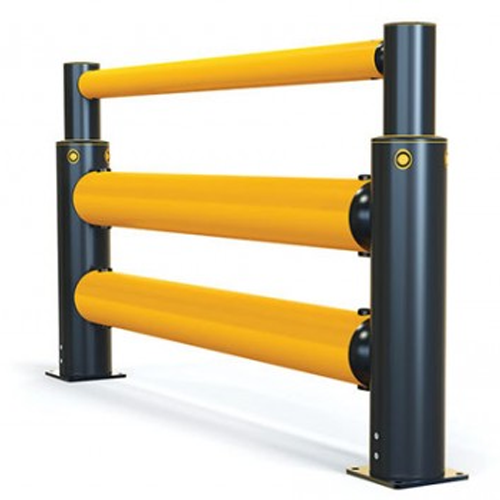
Individual bollards may be appropriate for protecting specific points, while a continuous barrier system may be more suitable where uninterrupted pedestrian segregation or physical separation is required.
The configuration should therefore follow the operational requirement rather than the other way around.
Frequently Asked Questions
What are flexible traffic bollards used for?
Flexible traffic bollards are used to guide vehicles, identify route boundaries, reinforce restricted areas and support pedestrian segregation. Depending on their specification, they can also provide impact protection when struck by a vehicle.
Where should traffic bollards be positioned?
Traffic bollards should be positioned according to actual vehicle routes, turning points, pedestrian boundaries and vulnerable areas. Their placement should provide clear guidance without unnecessarily restricting normal vehicle manoeuvring.
Can flexible bollards improve warehouse traffic flow?
Flexible bollards can make intended forklift routes and traffic boundaries easier to identify, which supports more predictable movement. Effective traffic flow still depends on appropriate route design, clearance and operating procedures.
How far apart should flexible traffic bollards be?
There is no single spacing suitable for every application. Bollard spacing should reflect the required level of access or segregation, vehicle dimensions, traffic behaviour and the purpose of the installation.
Are traffic bollards enough for pedestrian segregation?
Individual bollards can reinforce pedestrian boundaries, but they may not provide the same continuous physical separation as a dedicated safety barrier. Facilities should select protection according to the vehicle risk and required level of segregation.
Make Bollard Placement Part of the Site Layout
Good traffic management does not necessarily mean adding more barriers. In a Singapore warehouse or industrial facility, the more useful approach is to understand where vehicles actually travel, where they turn and which assets are most exposed to contact.
Flexible traffic bollards can then be positioned at the points where they provide a clear operational purpose, whether that means guiding vehicles through a confined area, defining a route or protecting a vulnerable structure.
The right solution will depend on the vehicles, site layout and operating conditions. Tysen Technologies supplies flexible bollards and other workplace safety solutions for warehouses and industrial environments in Singapore. Get in touch with the team at Tysen Technologies to discuss the appropriate bollard configuration for your facility.


